
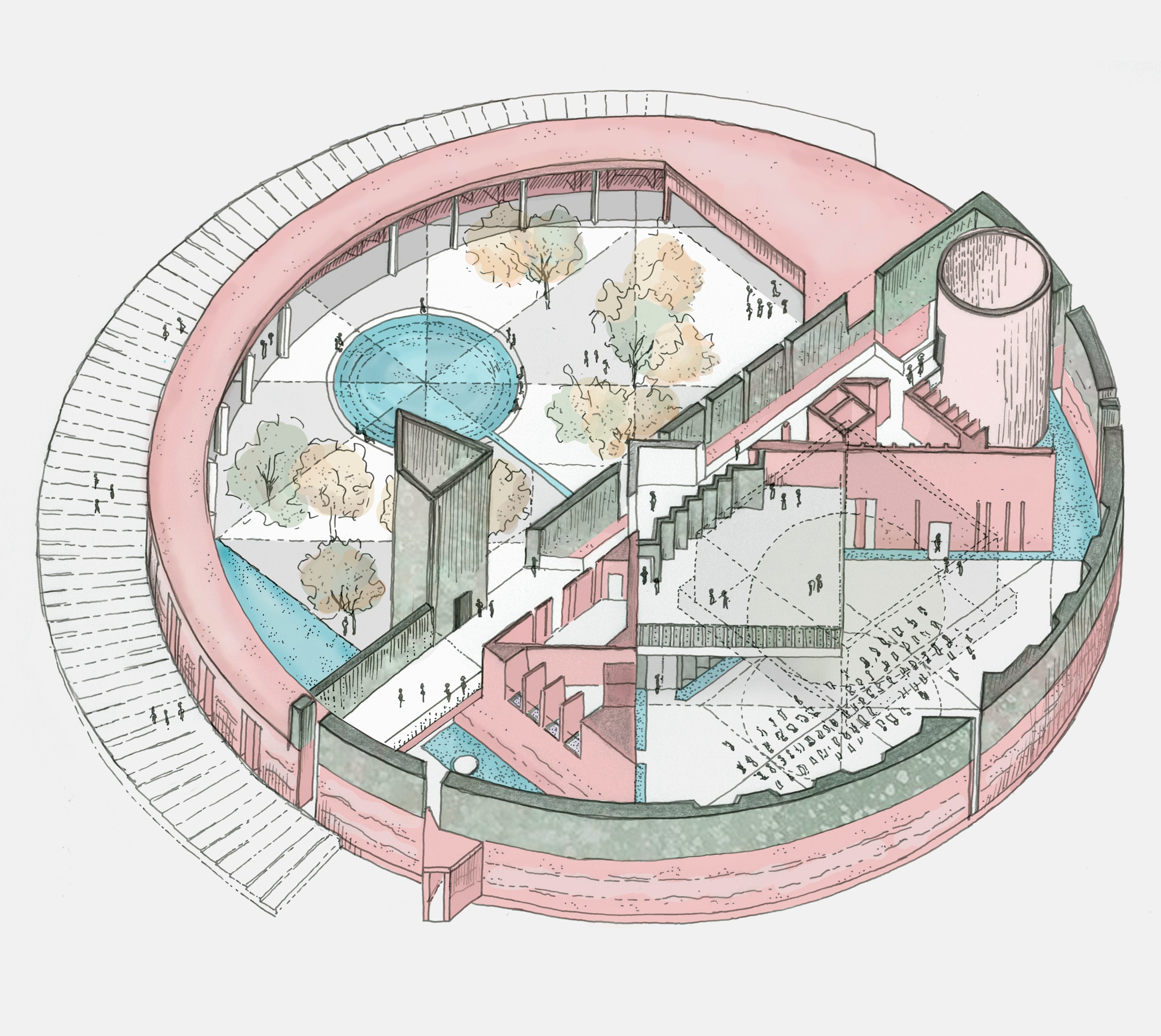
Our proposal for a new mosque at D’Urton Lane in north Preston takes cues from ideas of shelter, protection and community inherent in traditional and historical mosque design.
The form, mass and programmatic arrangement is influenced by the spaces within The Great Mosque of Kairouan, translating the ideas of sahn, portico, minaret and prayer hall into the form of a cylinder, that addresses the particular characteristics and challenges of our own site.

The elevated nature of the site and its proximity to the motorway and by-pass provide an opportunity for a landmark of significant architectural intervention externally, but an environment of peace, quiet, reflection and contemplation internally. The circle protects, encloses and prevents the noise of the motorway and surrounding roads from interfering with the sacred act of prayer and spirituality. The circular form also softens the impact of the scale; it allows for directions of movement and accessibility towards the mosque to be suggested from all sides. The lack of any corners externally means you are guided rather than repelled upon approach and arrival.


Our project acknowledges that arrivals will usually be from the south with the existing motorway bridge acting as a gateway and geographic marker. The proposal therefore provides pedestrian access from the southern edge of the site, in the form of a sweeping stair that follows the curvature of the thick and prominent rammed-earth walls forming the building’s external edge. This mode of arrival is inspired by the Moorish Alcazaba of southern Spain, promoting the idea of the building as a citadel sitting atop a hill providing seclusion and protection for the community. A minaret and stair tower are also located just beyond the courtyard to orientate outside visitors to the presence of the mosque.
The circle not only provides an architectural form of comfort and protection but also represents ideas of infinity, life and a continuous connection with Allah. The idea of continued reflection is embodied in not only the circular form of the building but also the introduction of water within the courtyard, prayer hall and study areas. These shallow pools of water play with light and shadow throughout the day as they glitter on the earthy materiality of the walls. They also provide a means of creating beautiful scenes viewed from within rather than beautiful vistas out; allowing the eye and the senses to be engaged with water, plants and the earth as opposed to the surrounding context of roads and motorway.


